By Dhruv Manoj
Singapore, the Chinese Wave, and the Limits of Flexible Identity
By the time you queue for your Luckin Coffee in a Jurong mall, wait behind a Mandarin-speaking family at a Haidilao in Orchard, or scroll past yet another headline about a Chinese tech firm “relocating” its headquarters to Raffles Place, something is happening that is larger than its individual parts. Singapore is in the middle of a quiet stress test – one that touches its economic model, its diplomatic identity, its racial politics, and its sense of self all at once.
The stress test has a name, at least for its corporate dimension: Singapore-washing.
The Art of the Clean Address
Singapore-washing describes the practice of Chinese companies reincorporating or establishing subsidiaries in Singapore to launder their geopolitical risk – to appear, on paper, as something other than Chinese. The logic is rational enough. In a world where “Made in China” is a regulatory liability in Washington and a due-diligence red flag in London, a Singapore address promises neutrality. Singapore is a rule-of-law jurisdiction, a member of no military bloc, a city that has spent sixty years marketing itself as a trusted, frictionless node in global commerce. For a Chinese firm seeking Western capital or Western markets, a Singapore shell is the corporate equivalent of a clean passport.
The case studies are now almost textbook. Shein, the fast-fashion giant built on Guangdong supply chains and algorithmic targeting of Western teenagers, moved its headquarters to Singapore in 2021. Its chairman spoke at investor roadshows about the company’s “American values.” It remained, by every substantive measure, a Chinese company: ten thousand suppliers in southern China, Mandarin-speaking engineering teams, business logic shaped by the same data-hungry culture as its mainland peers. The address changed; the company did not. Both a planned US IPO and a London listing collapsed under scrutiny.
Then came Manus, an agentic AI startup born from a Chinese firm called Butterfly Effect. In 2025, its founders made an unusually drastic move: they relocated the entire company to Singapore, terminated most of their China-based staff, and shut down domestic operations. The goal was to render the company “clean” enough for acquisition by Meta. For a moment, it seemed to work – Meta bought it for somewhere between two and three billion dollars. Then Beijing intervened. The founders were barred from leaving China. The Ministry of Commerce launched a national security review. The message from regulators was stark and, in retrospect, clarifying: technological nationality follows where the technology was developed, not where the company is registered. China was asserting that intellectual property built by Chinese engineers, trained on Chinese data, belonged to China’s jurisdictional domain regardless of what any corporate registry said.
The Manus case cracked the logic of Singapore-washing open. It turned out that the strategy was caught in a vice: it had never fully satisfied Washington, which always looked past the address to the founding team and the supply chain, and now it was no longer tolerated by Beijing either, which had decided that letting its best companies quietly exit via Singapore was not in the national interest. Singapore was left holding a brand promise – neutral, trusted, rules-based – that both superpowers were simultaneously eroding from opposite directions.
Money with a Passport
The corporate migration story is inseparable from the personal wealth story, and for a few years in the early 2020s, Singapore seemed to be winning both simultaneously. Between 2019 and 2022, direct investment from China into Singapore grew by thirty-five percent. In 2022 alone, the city attracted S$435 billion in new money – roughly seventy percent of its entire GDP in a single year. The banking sector boomed. DBS reported a forty-seven percent rise in wealth management fees in a single quarter. The Good Class Bungalows of Nassim Road and Cluny Park changed hands at prices that made local property commentators blink.
The drivers were structural. Xi Jinping’s “common prosperity” campaign made the ultra-wealthy nervous about the visibility of their assets in China. The regulatory crackdown on tech, real estate, and private tutoring industries destroyed fortunes overnight and made others feel precarious. Zero-Covid policies had made life in Chinese cities, for those who could leave, feel suddenly suffocating. Singapore offered low taxes, English-medium schooling, political stability, geographic proximity to China, and – crucially – discretion.
That last quality would become a problem. In 2023, Singapore conducted one of its largest-ever money laundering busts, seizing over three billion dollars in assets linked to a network of Chinese nationals holding multiple foreign passports. The scandal forced a reckoning. Banks tightened onboarding procedures. The government introduced more invasive background checks for family offices and permanent residency applicants. Wealthy Chinese clients, accustomed to a certain smooth frictionlessness, found themselves being asked to disclose the full composition of their families, the sources of wealth across multiple generations, the names of business associates in China.
The result was predictable. The net inflow of millionaires, which had been running at several thousand per year, slowed sharply. Frustrated clients began moving funds to Dubai, Tokyo, and Hong Kong instead. Singapore had tightened its regulations precisely because it valued its reputation – and in doing so, had made itself less attractive to the very people its reputation had drawn in. This is not an incoherent policy, but it is a tension the city will have to live with indefinitely.
The Taste of Somewhere Else
All of this — the corporate relocations, the wealth migrations, the regulatory battles – is largely invisible to most Singaporeans in their daily lives. What is visible, tangible, and increasingly contested is something more mundane: the shops.
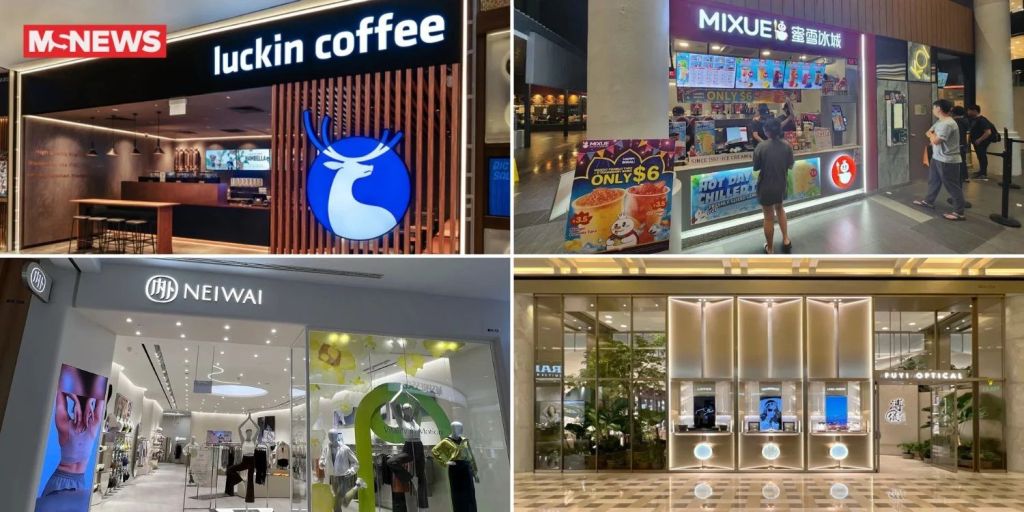
Walk through any suburban mall today and the Chinese retail presence is hard to miss. Mixue, the Chinese bubble tea chain that is by store count the largest food and beverage company on Earth, has dozens of outlets across Singapore. Luckin Coffee, which arrived in 2023, has over sixty. Haidilao – the theatrical, service-maximalist hotpot chain that is as much an experience as a meal – has been here for over a decade and continues to expand. Malatang, the Sichuan spiced skewer soup format, is everywhere. BYD electric vehicles charge in suburban car parks.
Some of this is straightforwardly good for consumers. These brands offer high quality at competitive prices. Younger Singaporeans, raised without the Cold War-era stigma around Chinese manufactured goods, engage with them unselfconsciously. An NUS Business School lecturer, speaking to Al Jazeera, noted that many of these brands are now perceived as “cool, modern, and emotionally in tune” with what young consumers want. There is something striking, even historically reversing, about a generation of Singaporeans who find mainland Chinese aesthetic sensibilities genuinely appealing rather than foreign or vaguely embarrassing.
But Rice Media, one of Singapore’s sharpest cultural publications, ran a piece that articulated a counter-feeling many locals recognise: as Chinese F&B brands flood the city, something about its culture, its inclusivity, and its sense of belonging is gradually being eroded. The anxiety is not about the food itself. It is about what happens to the texture of everyday life when the businesses that populate it are increasingly oriented toward – and staffed by, and designed for – a recently arrived demographic rather than a long-settled one.
This is where the social theory becomes useful. Singapore’s hawker centre is not just a food court. It is a deliberate multicultural institution – Chinese, Malay, Indian, and mixed-heritage stalls side by side, priced so that all can afford them, governed by policies that enforce ethnic diversity of vendors. It is on UNESCO’s Intangible Cultural Heritage list. The hawker centre is the banal, everyday enactment of the Singaporean national project: the idea that multiple communities can share space, share food, and produce something that belongs to all of them. When that space is displaced or surrounded by mainland Chinese chain restaurants staffed by Mandarin-speaking new arrivals serving a predominantly mainland Chinese clientele, the symbolic stakes are not trivial. The philosopher Michael Billig called this “banal nationalism” — the reproduction of national identity not through flags and anthems but through the small, unremarkable textures of daily life. Singapore is experiencing the disruption of its banal nationalism in real time.
The Problem of Co-Ethnic Tension
Perhaps the most sociologically interesting, and least discussed, aspect of this wave is the friction it generates within the Chinese community. To outsiders, Singapore is a Chinese-majority city; surely, one might think, the arrival of mainland Chinese migrants and capital is simply more of the same. This misunderstands almost everything about the history.
The Chinese Singaporean community was shaped by a profound rupture from China. When China officially curtailed emigration in the 1930s, the Singapore-born generations could no longer travel home or easily remit money. They became, over decades, something new: not Chinese in the mainland sense, but Singaporean Chinese – a distinct formation with its own dialects, foodways, political loyalties, and self-understanding. The PAP government accelerated this transformation after independence, suppressing dialect identities in favour of Mandarin as a unifying “Chinese” language, and simultaneously insisting that all citizens identify as Singaporean first. The result is a community that feels its Chineseness deeply but also feels, with equal depth, that this Chineseness is categorically different from the kind practised in Beijing or Shanghai.
Against this background, the arrival of mainland Chinese immigrants – wealthy, culturally assertive, often monolingual in Mandarin, sometimes visibly contemptuous of what they perceive as Singapore’s provincial version of Chinese culture – produces a peculiar and uncomfortable tension. Academics describe it as co-ethnic differentiation: the process by which ethnic kin distinguish themselves from one another on the basis of divergent histories and civic formations, even in the absence of racial difference. The tensions are real enough to have produced public incidents: the curry dispute, in which a mainland Chinese family objected to their Indian neighbour cooking curry; a 2012 strike by mainland Chinese bus drivers that broke Singaporean labour norms; a fatal accident by a wealthy Chinese national that crystallised anxieties about a class of newcomers who had bought their way into the country without buying into its social contract.
There is a Chinese internet neologism that captures the mainland view of Singapore with unintentional cruelty: po xian (坡县), roughly “Slope County” – the implication being that Singapore is a minor administrative subdivision of some larger Chinese cultural territory. Many Singaporeans, of all ethnicities, found it offensive not because of any linguistic nitpicking but because it named something that felt like a real threat: the reduction of a sovereign, carefully constructed nation-state to a provincial outpost of Chinese civilisational expansion.
Singapore’s Structural Dilemma
What connects the corporate, the capital, and the cultural dimensions of this story is a single underlying tension in Singapore’s model of existence.
Singapore has always been an entrepôt – a trading post, a node, a place whose value derives from being useful to everyone and owned by no one. Its economic logic requires openness, its diplomatic logic requires neutrality, and its social logic requires a civic identity strong enough to hold together a multiethnic population that has no shared ethnic homeland to appeal to. For sixty years, this combination worked remarkably well. Singapore became, improbably, one of the wealthiest and most stable societies on earth.
But the entrepôt logic and the sovereignty logic are now in deeper tension than they have been since independence. The entrepôt says: take the Chinese capital, attract the Chinese companies, welcome the Chinese tourists, host the Chinese brands, because that is what a neutral trading node does. The sovereignty logic says: if too much of the economy, the property market, the retail landscape, and the professional class is oriented toward or controlled by one external power, the neutrality that makes Singapore valuable begins to erode – and with it, the civic coherence that makes Singapore Singapore.
The sociologist Aihwa Ong coined the concept of “flexible citizenship” to describe how the globally mobile wealthy treat passports, residencies, and national identities as instruments to be picked up and set down as conditions require. Singapore-washing is the corporate version of the same logic. Both are deeply rational responses to the incentives of a world in which jurisdictions compete for capital and talent. And both place the receiving society in the same uncomfortable position: it is being used, intelligently and without malice, as a platform – and platforms do not have souls.
Singapore’s response to this challenge will define much of its next chapter. It has already begun tightening corporate transparency and AML regulations, at some cost to its attractiveness. It will need to develop, and articulate more clearly, a theory of what integration means for wealthy co-ethnic immigrants who arrive with capital and confidence but without the civic formation that local identity requires. It will need to think hard about urban space – about who the city’s retail and residential fabric is being shaped for, and whether the institutions of everyday multiracial life can survive being slowly priced or crowded out.
None of this requires hostility toward China or Chinese arrivals. Many of the new migrants are talented, entrepreneurial, and genuinely interested in becoming Singaporean in a full sense. The challenge is structural rather than personal: a city that has always defined itself as a crossroads is discovering that crossroads can be occupied as well as traversed.
Coda: What the Queue Reveals
Back to that Luckin Coffee queue. What you are standing in is, among other things, a small data point in a much larger reordering of the world. Chinese capital and Chinese culture are moving outward, finding new homes in cities that offer stability, openness, and rule of law – precisely the qualities China’s own political system has not consistently provided. Singapore benefits from this. It also bears the costs of it. The queue is not a threat and not an invasion. But it is a question, posed in the language of commerce and demography, to which Singapore has not yet given a fully satisfying answer.
The question is not whether to remain open. For Singapore, openness is not a policy choice but an existential condition. The question is whether it is possible to be open to the world – including, especially, to an increasingly powerful China – without becoming, gradually, a province of it.
Singapore has spent sixty years insisting the answer is yes. The current wave is the most serious test of that insistence yet.
Disclaimer: All views and opinions expressed belong solely to the author and do not necessarily reflect the views of any other organization, agency or institution that the author may be affiliated with. Any content by the author are opinions and are not intended to malign any religion, ethnic group, organization or individual that may have been mentioned.


Leave a Reply