“Thailand and Cambodia are two neighboring countries. It is best that we avoid conflict, it only brings losses and suffering”
~Anutin Charnvirakul
By Xavier Lim
Preface
The recent breakout of yet another border conflict between Thailand and Cambodia in May 2025 highlighted the inherited geopolitical issues from decades of colonial interference of modern day post-colonial states, alongside the impacts of nationalist sentiments fuelled by domestic policies that resulted in some of the fiercest fighting in Southeast Asia since the Vietnam War. This essay will cover the background, causes and key events in the border conflict that escalated into battles that were only resolved after millions of civilians displaced and seven long months of skirmishes.
The context
The main areas of fighting erupted around Cambodia’s Banteay Meanchey province and Thailand’s Sa Kaeo province. The zone hosts a number of historical temples and sites which are culturally significant to both Thailand and Cambodia due to the history of ownership experienced by the area to either aside at one point in time or another. During the Khmer empire in the 1400s at its peak, the empire stretched across what is today known as Cambodia, alongside large tracts of land that now belong to Thailand, Laos and Vietnam. Towards the collapse of the Khmer empire came the rise of the Empire of Siam that conquered large parcels of land that formerly belonged to the former. Towards the late 18th century, a severely weakened Cambodia, after repeated attacks and tensions between Vietnam and Siam, established friendly relations with French colonial forces that ultimately resulted in the French colonial takeover of Cambodia as part of French Indochina.
What is worthy of noting is that Cambodia’s Banteay Meanchey province and Thailand’s Sa Kaeo province fell under the territorial designations of both the Khmer Empire and the Empire of Siam, a fact that has given both Thailand and Cambodia the right to assert their ownership of the zones. In 1904 and 1907, French cartographers proceeded to survey the boundaries between both nations that resulted in two different drawings of boundaries about the conflicted zone, with the later 1907 version showing that the zone (alongside its temples) belonged to Cambodia, and the 1904 version showcasing the opposite of its later counterpart.
Modern criticisms have been raised over the geographical work of the cartographers due to the usage of the imprecise 1:200000 ratio of the maps at the time, whereas modern maps that are considered accurate and in use by conventional navigators use the more precise 1:50000 ratio. Such imprecision has thus led to ambiguity over the true ownership of the area with respect to historical records.
It was only a couple decades after the circulation of the 1907 French maps that Thailand began to raise concerns over the map’s accuracy and sent its own team of surveyors which then discovered the mistake made in the French maps over the boundaries regarding the conflicted zone.
This discovery by the Thai authorities thus contributed to a slew of bickering between Thailand and Cambodia in the next few decades before the unanimous decision was made by both parties to submit their arguments and the case over for a judgement to be made by the International Council of Justice (ICJ). In 1962, the ICJ ruled in favor of the Cambodians, partly due to the notion of the Thai lack of criticism over the 1907 French maps until decades later, indicating the possible acceptance of the boundaries as demarcated by both parties initially. Thailand, however, did not accept the ruling. Following the ICJ decision, discussions over the zone died down in favour over more pressing domestic concerns including the rise of the Khmer Rouge and the outbreak of the Vietnam War, as well as the subsequent invasion of Cambodia by Vietnam that ousted the Khmer Rouge and resulted in the military occupation of Cambodia for over a decade. It was only after the independence of Cambodia and the stabilisation of its internal politics by the election of the Cambodian prime minister Hun Sen that enabled the revival of debate over the zone.
In 2008, Cambodia decided to submit the temple of Preah Vihear to UNESCO to be declared as a world heritage sight, which drew immediate criticisms from Thailand due to fears from the latter that the awarding of the UNESCO world heritage site title for the temple as submitted by Cambodia would give the international community the impression of a firm Cambodian ownership of the temple and the surrounding zone. When UNESCO eventually awarded the title, tensions between both countries erupted that resulted in the 2008 to 2011 border crisis. In 2011, Cambodia requested a clarification from the ICJ on its 1962 ruling of the ownership of the conflict zone, where the ICJ reiterated its 1962 stance, much to Thai anger.
Political legacies
It is relevant to note the similarities in the political dynasties of both countries. Cambodia was ruled by the prime minister Hun Sen from 1985 to 2023, making him one of the longest political figures to hold office in Southeast Asia and a continued voice of prominence over Cambodian politics till this day. After he stepped down from the role of prime minister in 2023, he then enabled the succession of the role by his son, ensuring the continued legacy of the Hun political dynasty that has survived the conflict.
As for Thailand, the Thai political system is characterised by a splitting between the civilian leadership democratically elected by the common people, and the military institution that is regarded as an entirely separate political entity often aligned with the interests of the monarchy. Unlike Cambodia, civilian leadership in Thailand is neither straightforward nor stable due to the inherent risk of successful political coups executed by the military each time civilian political leaders threaten the interests of the military, with no less than 13 successful coups on the civilian government. However, such has not prevented the establishment of the Shinawatra political dynasty starting with the election of prime minister Thaksin Shinawatra in 2001 until his overthrow in 2006, which was succeeded by his sister Yingluck Shinawatra from 2011 to 2014 and his daughter Paetongtarn Shinawatra in 2024 to 2025.
Between the various conflicts over the border issue from 2008 to 2011, it was reported that the two political dynasties had shared a cordial and friendly relationship, particularly between Hun Sen and Thaksin Shinawatra, which continued even after the self-initiated exile of Thaksin Shinawatra following his overthrow in 2006 that saw the frequent visiting of Shinawatra over to the Hun Sen residence in Cambodia, where the former served as the latter’s political advisor. As much as such a relationship could have allowed for the prevention of the conflict owing to a direct diplomatic channel between both sides, the friendship between both parties was not to stand up to the political strains exerted by the commencement of the 2025 border war
The clash
The conflict first started in May 2025 with tensions again reaching a boiling point over an incident involving Thai soldiers stopping Cambodian tourists from singing their national anthem at the Preah Vihear temple that ended with a skirmish between Thai and Cambodian soldiers, leaving one Cambodian soldier dead. Both sides, naturally, blamed the other over the cause of death of the soldier.
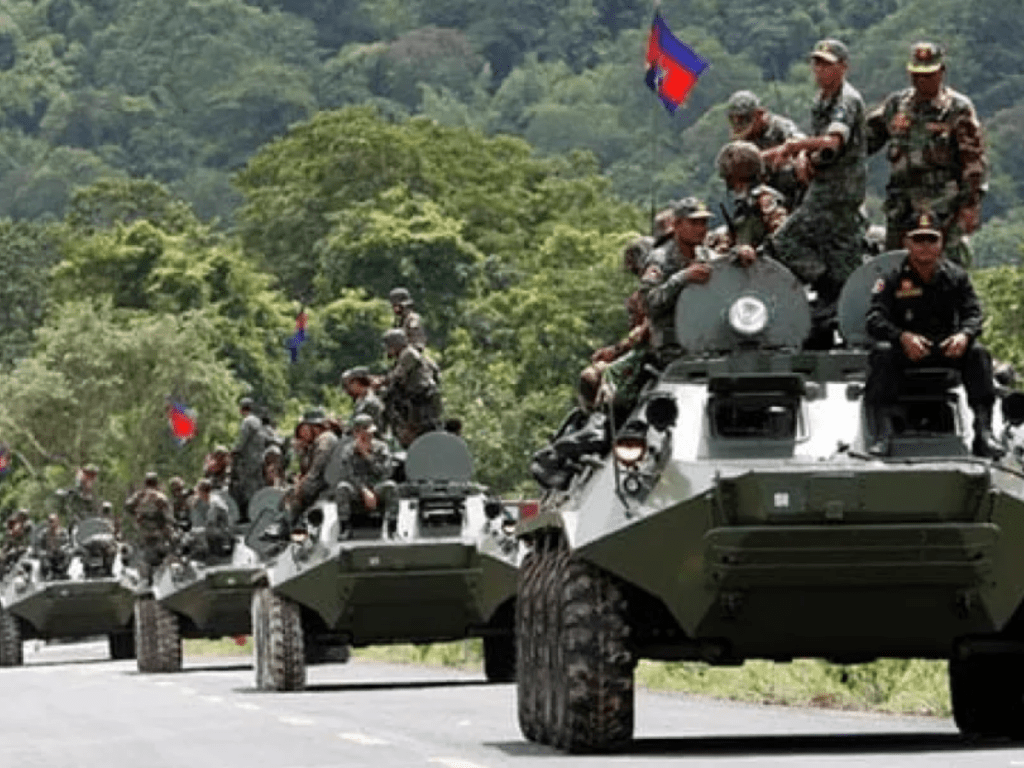
Tensions rose further in July 2025 when the Thai military discovered the presence of landmines laid along the conflict zone after a Thai soldier lost his leg in an accidental detonation of a buried antipersonnel landmine, with Thailand immediately accusing Cambodia of setting anti-personnel threats and following up with the mass deployment of troops to the area. Cambodia followed suit with the amassing of infantry and armour assets along the border in response to what was perceived as Thai aggression. Following the commencement of military engagements along the border, Thailand downgraded its diplomatic relations with Cambodia via the expelling of Cambodian diplomats and the withdrawal of its own diplomatic envoy from Cambodian territories.
It was only after pressure from the United States that both nations agreed to a diplomatic meeting, hence resulting in a temporary ceasefire. As both parties met in an ASEAN meeting chaired by the ASEAN chair at the time, Malaysia, Cambodia and Thailand agreed to halt hostilities along the border. However, peace was not to last as relations deteriorated within months with the resumption of a full-scale conflict in November that only escalated in December the same year. It is unclear what caused the resumption of conflict, with reports pointing towards accusations by Thailand of the alleged planting of new landmines by Cambodia after a few Thai soldiers were injured in a landmine explosion along the border.
Owing to both US and Chinese interests in the region, both the United States and China played a key role in pressuring Thailand and Cambodia to reach an agreement that would result in a permanent ceasefire. Due to close relations between the US and Thailand, and between China and Cambodia, both parties were forced to agree to a peaceful resolution of the conflict lest they risk economic and military cutbacks from their larger partners.
Domestic politics and geopolitical impact
What is interesting about the conflict is the role it played in possibly putting an end to the Shinawatra dynasty in Thai politics after the removal of Thai prime minister Paetongtarn Shinawatra from her post in June 2025. As mentioned earlier, the splitting of political lines between the civilian leadership and the military has resulted in numerous attempts by the military in usurping the civilian leadership to retain the latter’s control over domestic affairs in the country.
At the same time, the actions of Thaksin Shinawatra inevitably played a role in the creation of many political enemies that would have eventually come around to contribute towards the downfall of his daughter’s political career. During his election in 2001, Thaksin Shinawatra was already a leading businessman and a billionaire, where he then proceeded to use his political power as prime minister to aid the growth of his business. This angered the leaders of large business competitors in the local Thai economy due to the accusations of political bias and unfairness, hence raising the anxieties of prominent business leaders over fears for their own businesses in competition with the government-backed enterprises of Shinawatra.
At the same time, the popularity enjoyed by Shinawatra alarmed the military due to fears of the level of influence held by Shinawatra over the local populace, raising concerns within Thai elite circles of the influence that Shinawatra could potentially use to threaten the long-standing powers held by the military and monarchy. This is especially in the context of the transition of the Thai political system from an absolute monarchy to a constitutional monarchy which retained the reverence of the monarch by the civilian population in view of cultural norms.
The build up of tension between Thai elites and the Shinawatra dynasty came to a climax in June 2025 after the deliberate leaking of a private phone call between Thai prime minister Paetongtarn Shinawatra and Hun Sen, where the former had attempted to use the informal cordial relationship shared between both families as leverage for the negotiation over the border issue. In the phone call, Shinawatra was heard to have referred to Hun Sen as ‘uncle’, a term of endearment in Southeast Asia, and stated her criticisms of the Thai military leadership whilst asserting that both the Shinawatras and the Hun were aligned against the ‘others’, a term interpreted as referring to the military and the monarchy.
The leaking of the phone call thus resulted in a national outpouring of anger towards the Thai prime minister, where the phone call was framed by the Shinawatra political opponents as an expression of the lack of solidarity shared between Shinawatra and Thai interests. At the same time, political opponents were quite to accuse the standing prime minister for treason and accused her of aligning with the Cambodians over the contentious issue of the border conflict that evolved into a stand-off between Thai and Cambodian interests over a culturally significant zone. The saga thus led to Paetongtarn Shinawatra stepping down as prime minister in June.
It was thus unfortunate that the leaking of the phone call occurred just at the peak of Thai nationalism that surged throughout the country over the announcement of the conflict, with a significant portion of Thai nationalist hardliners referring to the conflict zone as areas that are lost territories with regards to Thai territorial boundaries.
Political analysts have also pointed to the reasoning behind the deliberate move made by the leaking of the phone call by Hun Sen, indicating the possible disgruntlement of Hun Sen over views that the Shinawatra dynasty has been incompetent in retaining long-lasting political power unlike the Hun dynasty, hence further complicating channels for possible negotiations between both the sides. At the same time, the escalation of the conflict was said to have played out favourably for the Thai elites opposing the rule of the Shinawatra dynasty, seeing such as an opportunity to utilise the growing nationalist wave to turn the civilian population against Paetongtarn Shinawatra in light of the possible alignment of the younger Shinawatra with Cambodian interests, and hence deny the chance of re-election for members of the Shinawatra lineage.
In the conflict that oversaw the clashing of both nations and the utilisation of military assets, it was unsurprising to see both sides experience waves of nationalist support, which rendered the possibility of either side backing down moot. In a conflict of such high stakes as to involve the public perception of their own respective governments, neither had the political willpower to be the first to call for a ceasefire without the intervention of major powers, a fact that both the US and China recognised.
Peace and stability in Southeast Asia
The incident highlighted the willingness for both sides to engage in a prolonged clash despite the obvious military superiority of the Thai military. With five times the budget and over four times the number of active personnel, on top of a larger quantity and quality of armour, air and naval assets, the conflict was disproportionately in favour of the Thai military which claimed multiple military successes across the multiple skirmishes along the border.
Finally, it is also worth noting the inability for ASEAN to have effectively pushed for a lasting resolution of the conflict without the help of the major world powers with stakes in the region. Such is understandable, given that ASEAN is a consensus-based regional platform aimed at facilitating regional discourse without military intervention from any ASEAN members, but concerns were also highlighted of the possible implications that could have been spelt for ASEAN should future conflict break out between member states, without the aid of major powers in settling the conflict.
It remains to be seen how ASEAN will play a key role in the easing of tensions between Thailand and Cambodia in the coming decades, given the noted ambiguity of the terms of the ceasefire that has yet to address the fundamental uncertainties regarding the boundary lines between Thailand and Cambodia.
Disclaimer: All views and opinions expressed belong solely to the author and do not necessarily reflect the views of any other organization, agency or institution that the author may be affiliated with. Any content by the author are opinions and are not intended to malign any religion, ethnic group, organization or individual that may have been mentioned.


Leave a Reply