“The Chinese people know we should speak to the invaders in the language they understand: that is to end war with war, stop invasion with force, and earn peace and respect with victory.”
~Xi Jinping
By Xavier Lim
Preface
China’s rapid rise and industrialisation within the last few decades showcases the revertion of the world order towards a historical norm, taking into context the geopolitical dominance displayed by the various Chinese civilisations since millenia. It was only in the past two centuries did China undergo reforms, revolutions and transformations on a scale almost unheard of due to a combination of the intensity and population size encompassed in the major historical events that have led to China’s current place on the world stage.
A brief history
For most of recorded human history, China has remained at the forefront of civilisational and military technology, being one of the first human civilisations to establish itself and holding an impressive track record of cultural survival. Despite its many expeditions and conflicts with its neighbours, with some imperialistic tendencies involving the annexation of territories like Tibet, China has remained relatively isolationists as compared to the more recent examples of European empires during the age of colonialisation.
Following the establishment of formal diplomatic ties between the British empire and the Qing dynasty, it wasn’t long before the European powers expressed their interest in engaging with trade with China in pursuit of precious commodities that held high monetary value back home. Porcelain, jade and silk were just some examples of goods that European merchants set out to acquire before selling these items back home at high prices. Due to the large inflow of silver towards the Chinese government in exchange for Chinese goods, the British attempted to resolve the balance of trade via the introduction of opium from India into the local Chinese economy as a form of illegal exports. This enabled the creation of a flow of silver back into British coffers which was previously absent due to a lack of demand for European goods amongst the Chinese.
As with any introduction of addictive substances into large communities of individuals, the explosion of popularity of opium due to the surge in supply from the British resulted in mass addiction within the local Chinese peasantry. At the same time, the growing rates of addiction and corruption within the Qing government served to only increase the demand for opium in China despite the Qing government outlawing the drug, enabling the British to extract large quantities of silver out of the Chinese economy back into British hands on top of weakening the local Chinese economic and social landscape due to the prevalence of opium addiction that severely hampered the ability for individuals to work and fulfil their social roles. When the Qing government realised the extent of the problem, they attempted to halt the flow of opium via the total strangulation of economic activities between the British at Canton and its economy, with the British responding by declaring war on the Qing government.
This kickstarted the First Opium War which saw the Qing defeat at the hands of the British, of which the latter made a set of demands that included the opening of more ports for foreign trade and the ease of trade between British merchants and Chinese traders. Most outrageous among the demands was for the legalisation of Opium, further worsening the opioid epidemic rampant in China.
Following the First Opium War came a string of European interventions that eventually led to the commencement of the Second Opium War, which unsurprisingly resulted in yet another Qing defeat that opened up more avenues for European trade along the mainland, a loss of territory and the extraction of war reparations from the Qing government, hence further weakening an already shattered economy. Combined with a host of severe internal problems plaguing the central Qing government, China remained reluctant to modernise and industrialise along European models of development, which was a lesson not lost upon Japan which kickstarted the Meiji Revolution in 1868 after witnessing the fate of China.
In between the Meiji Revolution and the Second Sino-Japanese War saw China embroiled in more conflicts with European powers that stripped more of its territory. With the outbreak of the Second Sino-Japanese War following the Japanese invasion of Manchuria, China emerged from the end of the Second World War with severe infrastructure damage and mass civilian trauma over the atrocities committed during the brutal Japanese occupation. The period from 1839 to 1949 would thus come to be known as ‘The Century of Humiliation”.
The surrender of the Japanese thus enabled the resumption of the conflict between the Chinese nationalist forces and the communist party, which culminated in a communist defeat that forced the Kuomintang (KMT) to flee and establish another republic on the island of Formosa, now known as Taiwan. This thus saw the proclamation of the People’s Republic of China (PRC), the current political state of China that still survives this today.
Since the establishment of the PRC and the modern day, Chinese society has been rocked by a slew of significant events that saw death tolls numbering in the tens of millions during the early developmental stages of the country. From the failed Five-Year Plans initiated by Mao Zedong, the first leader of communist China and whom the political ideology of Maoism was named after, to the man-made famines and the cultural revolution, modern Chinese history tells of multiple struggles between the populace and the ruling party. As with the evolutions of the Chinese political systems under different leaders, one similarity is the tip grip on political power held by the Chinese Communist party (CCP) over the population, alongside a strict allegiance pledged by the military not to serve the people, but for the use of the CCP at its discretion.
After the death of Mao Zedong, the succession by Deng Xiaoping saw the steep growth experienced by the Chinese economy that has led to China’s current economic power, alongside a range of liberalisation regarding the political climate in the post-Mao era. What defined the Deng Xiaoping era of Chinese geopolitics was the establishment of diplomatic ties with nations that did not share China’s political ideologies whilst keeping bilateral relations to a pragmatic maximum, free of controversy. Such allowed the media coverage of Chinese developments to be low during the period of American hegemony after the fall of the USSR, such that Chinese goods were able to infiltrate local markets around the world due to the rise of industrialisation regarding the manufacture of consumer goods that set the stage for the next generation of economic development in China.
Modern China
China as of 2026 has become a world power second only to the United States (US), managing to rival the US in both economic output and technological research and development. Due to the pace at which Chinese industries were able to tap into modern production technologies alongside rapid growth of local entrepreneurship, certain Chinese industries are known for world-class developments, such as digital technology, defense technology and quantum research.
Coinciding with China’s growth is the decline of US hegemony in the Asia-Pacific, where China is increasingly asserting its claims on territorial land and waters surrounding its borders, with border conflicts between India and China being one notable example of China’s newfound ability and willingness to use military force in achieving its goal under the Xi Jinping administration. At the same time, there has been deep controversy surrounding the South China Sea and the East China Sea, where China is asserting its right to own large tracts of international waters via the usage of historical rhetoric, which has been largely rejected by neighbouring states who depend on the access to such international waters for reasons related to maritime economic activities and the protecting of sovereignty.
At the same time, the war between the US and China has resulted in tariffs being placed on the exports of both sides, with recent escalations due to the re-election of US president Donal Trump who promised additional tariffs on Chinese goods. In retaliation, Beijing followed with tariffs on US goods entering China, resulting in inflation of consumer goods that has largely affected the US population more than their Chinese counterparts due to a more extensive local manufacturing base of Chinese consumer products.
Other nations are also beginning to recognise the rise of China and the importance of establishing diplomatic and economic channels which aid the flow of goods and political goodwill. The Belt and Road Initiative, initiated by Beijing, will see the construction of economic facilities across Asia, Africa and Europe to facilitate greater economic exchange between China and over 130 countries that have benefitted from financial exchanges, infrastructure development and foreign direct investment.
US-China tensions
Tensions between Washington and Beijing have ramped up in the past decade since China’s rise to become a world power and the shift in Chinese foreign policy towards a more confrontational approach under Xi Jinping.
While China is both unwilling and unable to replace the US as the world’s hegemon, it has shown its willingness to challenge the US dominance in the Asia-Pacific, a region which China considers its own backyard due to the geographical proximity between itself and neighbouring states allied with the US. Given the proximity between China and the US allies of South Korea and Japan, conflicts between both sides over issues regarding the East China Sea often bring the US into discussions due to accusations from Beijing that allege the confluence that Washington casts over both nations.
Deep historical scars between China and Japan, whom the former considers as not having done enough to amend for the extensive damage caused during the Second Sino-Japanese War, result in deep seated mistrust that cause diplomacy between both countries to be problematic and prone to flashpoints, such as during Shinzo Abe’s visit to the controversial Yasukuni Shrine in Tokyo.
Such mistrust runs parallel with relations between China and Korea, where the crucial role that the US played in the development of South Korea and the official alliances between South Korea and the US have led Beijing to opt for closer partnerships with the diplomatically isolated North Korea, where North Korea functions as a semi-proxy to China due to the former’s heavy reliance on China for trade and economic aid. It does not help that South Korea and Japan were formalized as part of the United States led initiative to form a defensive belt that stretches downwards to the Philippines in a bid to contain Chinese military expansion.
This is in line with the US strategy of containment which has been stressed by Washington across different administrations as the overarching Asia-Pacific strategy employed by the US for the next few decades for as long as the US maintains its presence in the region. The deployment of US naval assets alongside the officiating of alliances with countries along China’s periphery serve as potential flashpoint against a China that is increasingly seeking to establish its own dominance in the region, and considers American attempts to contain it as threats to sovereignty.
Recent events highlighting relations between Washington and Beijing have involved instances of fierce ideological rivalries that resulted in sweeping economic actions taken to damage economic prospects by both sides and threats exchanged between both governments, to occasional instances of dialogue. One major aspect of tensions is the economic rivalry between both nations, where both compete for dominance over a singular interconnected global system (quite unlike the US competition with the USSR featuring the clashing of two separate systems), ensuring that neither nation can entirely decouple from the other despite attempts at market diversification and the safeguarding of supply chains of crucial components such as semiconductor chips.
The economic competition between the US and China serves as the primary concern between both nations since the commencement of the trade war in 2018 with the first implementation of tariffs under president Trump. Despite both nations reaching a consensus that neither side benefits from an extended trade war that has driven up prices of consumer goods across the board and resulted in inflation, neither side has the political willpower to back down against what each sees as their primary rival on the world stage.
The issue of certain Chinese products penetrating the US market has also raised concern over national security issues, with the ban on the use of Chinese-produced devices for government offices and the forced selling of Tiktok to a non-Chinese company under president Biden. While China has denied the use of such components for the purposes of espionage, evidence has surfaced of the ability for information stored and received by Chinese electronics and software to be transferred to overseas third parties.
The competition over semiconductor chips also plays into the technological competition between both nations, where the acquisition and protection of a steady supply of chips would enable either side to make rapid gains over the other in terms of defense technology, artificial intelligence and research and development that would further play into the growing sophistication of both economies. The fierce competition to lead global industries on technology and AI has caused conflicts over questions of key supply sources, including Taiwan which produces roughly 90% of the world’s semiconductor chips.
Taiwan stands alone in its unique struggle against the PRC in its battle for sovereignty against a China that has pledged to retake control over Taiwan in the next coming decades. Despite backings from the US, Taiwan is dwarfed by the PRC in all aspects of geopolitics from diplomatic ties to economic and military power. Among accusations by Beijing on the heavy influence cast by Washington on decisions over Taiwan are the ideological and historical differences that mark the relationship between both China and Taiwan, with Taiwan set to become a possible flashpoint should China continue the trend of ramping up its military presence in the Fujian region near Taiwanese shores. The control over Taiwan would enable China to obtain a steady supply of computer chips crucial for further economic sophistication on top of gaining territorial expansion that would serve to disrupt the US strategy of containment of Chinese assets.
The world is increasingly pressured to pick sides between China and the US due to the attempts at economic decoupling, despite the silent consensus between both nations that either side must resign to a coexistence that would likely result in fierce competition for the dominance of a single global economy, where neither side can ultimately remove the other without an all out nuclear war.
The South China Sea
Aside from the many controversies and tensions plaguing the bilateral relations between the East Asian states, the South China Sea has also presented opportunities for flashpoints between China and the Southeast Asian states that have expressed differing assertions regarding the rights to ownership over the territories of the sea.
Considering that 80% of Chinese exports travel through the South China Sea and pass through the Straits of Malacca, it is understandable that Beijing is interested in not only establishing its presence in the region, but also having military and political control over the sea that would allow for the safeguarding of Chinese interests and a form of expansion that would challenge the US attempts at containing Chinese expansion.
Most pertinent are the disputes over the ‘Nine-Dash Line’ outline by Beijing that states the vast central majority of the South China Sea belongs to China, despite the presence of international waters and zones belonging to the Southeast Asian states of the Phillipines, Vietnam, Malaysia, Indonesia and Brunei.
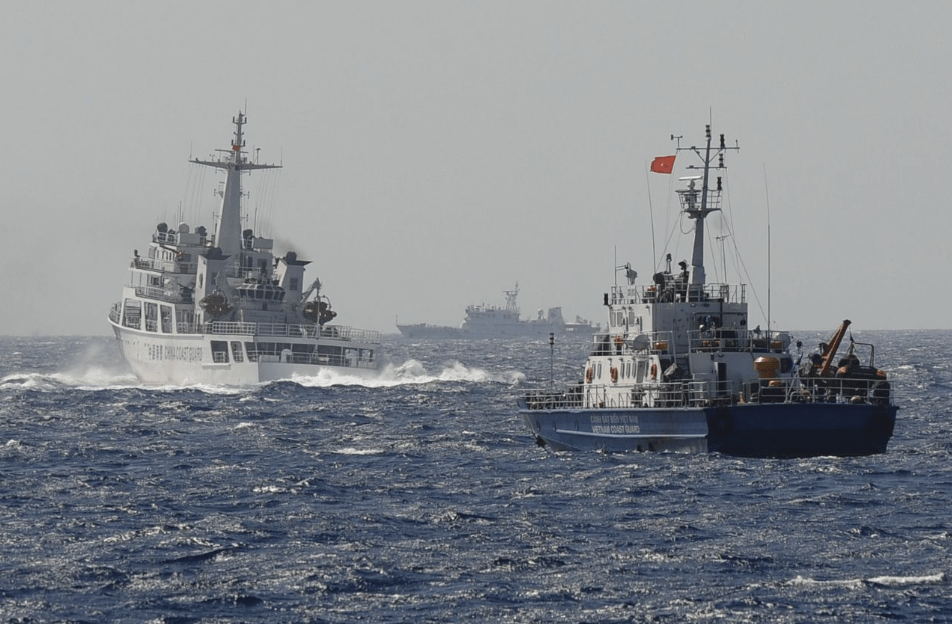
Full control of the South China Sea would give China access to billions of barrels of crude oil, trillions of cubic feet of natural gas and key shipping lanes on top of exclusive maritime fishing zones that would all serve to bolster Chinese military and economic influence in the region as a direct challenge to US presence. This has led to various confrontations between Southeast Asian states and Chinese naval assets, which famously culminated in repeated reports of harassment of Filipino fishermen by Chinese naval craft that claimed the waters as their own. At the same time, much to the anxieties of ASEAN, China has increased the construction of islands and the militarisation of the South China Sea after it rejected the verdict by the United Nations that declared the sea to be part of international waters, citing historical narratives.
The situation is further complicated by the friendly partnerships shared between ASEAN states and the US, with ASEAN seeking to encourage the continued presence of the US in the region as means of counterbalancing a China that the smaller states of Southeast Asia see as expansionist and a possible threat to sovereignty, much to the displeasure of China which has used various means of convincing institutions to pressure governments into siding with Chinese interests. Some of these attempts at influence have raised criticisms of foreign influence on behalf of China, from appeals to ethnic Chinese populations residing in ASEAN nations to reports of propaganda infiltrating local media, much to the denial of China.
Time will tell if the combined diplomatic efforts of ASEAN would enable a consensus based approach towards the re-liberalisation of the waters of the South China Sea despite competing claims from both sides of the conflict claiming identical narratives of sovereignty. As for the current geopolitical situation, the presence of the US would be key to contributing to credible checks and balances on further Chinese expansion in the region.
Conclusion
China is projected to develop economically, militarily and culturally in the coming decades as layers of institutional and technological advancements overlap to drive growth across all sectors of its national growth. It would be foolish for any nation that seeks diplomatic legitimacy to neglect its relations with China, given the immense political weight carried by the East Asian giant across diplomatic and economic platforms. However, nation states are increasingly pressured to pick a side in the long-standing rivalry between the US and China as both attempt to maximize channels for decoupling, much to the chagrin of non-aligned nations and countries that heavily depend on both sides to fulfill significant economic and political obligations.
Only time can tell what the outcome may be of the bilateral rivalry between the US and China that has come to define the first few decades of the 21st century, wherein each state seeks to gain an upper hand that would enable it to cast the dominant shadow over future global geopolitical decisions. Just as China has expressed its ambitions to challenge the hegemony enjoyed by the US, the US is not projected to engage in any sudden large-scale withdrawals of its global influences. Whichever side that emerges the undisputed winner of the current world order will be crowned as the world hegemon for decades to come.
Disclaimer: All views and opinions expressed belong solely to the author and do not necessarily reflect the views of any other organisation, agency or institution that the author may be affiliated with. Any content by the author are opinions and are not intended to malign any religion, ethnic group, organisation or individual that may have been mentioned.


Leave a Reply